
Malaysia’s airport network is a masterful blend of world-class infrastructure and regional character, designed to welcome millions of travelers into the heart of Southeast Asia.
Whether you’re landing at the iconic KLIA, the efficient hub of klia2, the lush runway of Kota Kinabalu International Airport, the historic Penang International Airport, or any other key regional gateway, each facility offers a distinct first impression of the nation’s diverse landscapes and cultures.
Understanding the layout, services, and unique features of these airports is the first step in planning a seamless journey, transforming the point of arrival from a mere transit zone into the beginning of your Malaysian story.
Let’s explore the terminals that connect the world to this vibrant country.
Kuala Lumpur International Airport (KLIA) Terminal 1 is the main international airport of Malaysia and a leading aviation hub in Asia. It is located at Sepang District of Selangor, approximately 45 km south of the Kuala Lumpur city centre.
KLIA Terminal 2 (klia2) located in Sepang, Malaysia is a regional aviation hub for both domestic and international low-cost carriers. It is built to accommodate the growing demand for budget air travel, particularly AirAsia.
Sultan Abdul Halim Airport / Alor Setar Airport, is an airport in Kepala Batas, Kedah, Malaysia.
Bintulu Airport stands 5km southwest of the city center. It is a beacon of connectivity for Bintulu.
Sultan Azlan Shah Airport / Ipoh Airport, the 15th busiest airport in Malaysia, is situated 6km from the city center.
Sultan Ismail Petra Airport / Kota Bharu Airport serves as a vital link between travelers and Kelantan.
Kota Kinabalu International Airport is an international airport in Kota Kinabalu, Sabah, it’s about 8 km southwest of the city centre.
Sultan Mahmud Airport / Kuala Terengganu Airport is located in Kuala Nerus, positioned near Kuala Terengganu.
Sultan Haji Ahmad Shah Airport / Kuantan Airport serves a vital link between travelers and Kuantan in Pahang.
Kuching International Airport plays a pivotal role in connecting Kuching to major cities across Malaysia.
Labuan Airport serves the federal territory of Labuan in Malaysia. The airport is 2.5 km by road from the Labuan town.
Langkawi International Airport, is nestled in the picturesque town of Padang Matsirat on the enchanting island of Langkawi, situated in Kedah.
Malacca / Melaka Airport is located about 10km from Melaka city, which is classified as a Unesco World Heritage city.
Miri Airport is an airport located 9.5 km south east of Miri, a city in the Malaysian state of Sarawak.
Penang International Airport is situated 16km south of Georgetown, the capital city of Penang, and connects with all major cities in Southeast Asia.
Sandakan Airport serves as a vital link between the bustling city of Sandakan and the world beyond.
Senai International Airport is an airport located in the town of Senai near the bustling city of Johor Bahru.
Sibu Airport is located 23 km (14 mi) east south east of Sibu, a town in the state of Sarawak in Malaysia.
Subang Skypark Terminal at Sultan Abdul Aziz Shah Airport (SAASA) is situated approximately 20km west of KL’s city center.
Tawau Airport is situated in the town of Tawau in Sabah, playing a crucial role in facilitating travel, trade exchange.
Each airport, from the sprawling capital hubs to the compact regional terminals, is more than a collection of runways and gates — it is a curated introduction to the destination that awaits.
KLIA whispers grandeur, Kota Kinabalu promises adventure, Penang offers heritage, and klia2 delivers pure efficiency. Whether you’re a first-time visitor or a frequent flyer, we hope this overview provides the clarity needed to move smoothly from the sky to the street.
For the most current flight details and specific services, always check with your airline and the respective airport authority. We wish you safe travels, smooth connections, and an unforgettable experience exploring the wonders of Malaysia.
Selamat datang dan selamat jalan — Welcome, and have a pleasant journey!
KLIA Terminal 2 (klia2) is Malaysia’s answer to the low-cost travel revolution. Strategically built in Sepang, this future-proof terminal was designed from the ground up to efficiently serve 45 million flyers every year.

klia2 is designed to be the Next Generation International Airport Hub for Malaysia to facilitate seamless connectivity for both local and international low-cost & full-service carriers. The terminal started operating on May 2, 2014.
As the primary aviation gateway to Malaysia and a crucial hub for Southeast Asia, KLIA & klia2 terminals host a diverse ecosystem of carriers, connecting the nation to over a hundred destinations across six continents.
From the full-service elegance and global network of the national carrier, Malaysia Airlines, at KLIA Terminal 1, to the dynamic hub of low-cost aviation led by AirAsia at klia2, many airlines at these terminals collectively form the vital arteries of Malaysia’s connectivity, offering choices that cater to every travel style and destination.
Malaysia Airlines is a major airline operating flights from KLIA Terminal 1 and from secondary hubs in Kota Kinabalu and Kuching to destinations throughout Asia.
Batik Air is a rapidly expanding Malaysian-based airline with its main hubs at the KLIA Terminal 1 in Sepang and Subang Skypark Terminal at Subang in Selangor, Malaysia.
Firefly is a full-service point-to-point carrier and a full subsidiary of Malaysia Airlines. Based in Petaling Jaya, Selangor, it claims to be the first community airline in Malaysia.
AirAsia is a low-cost airline that operates in Southeast Asia with its main hub based in KLIA Terminal 2 in Sepang, Malaysia.
AirAsia X is a prominent carrier in the low-cost carrier (LCC) market since its inception. It’s based in KLIA Terminal 2.
Handy tool to check arrivals and departurs flight schedule at KLIA Terminal 1 and KLIA Terminal 2.
Whether you are a business traveler seeking seamless global connections, a budget-conscious explorer embarking on a regional adventure, or a visitor planning your journey to Malaysia, understanding which airline operates from which terminal is the first step to a smooth trip.
★ Check out Airlines at KLIA & klia2 to get a clear overview of the major airlines, their operational bases, and the distinct travel experiences they offer, empowering you to navigate your options with clarity and confidence from the moment you book your ticket.
Kuala Lumpur’s travel network is anchored by KL Sentral, its central rail interchange, and Terminal Bersepadu Selatan (TBS), the main express bus terminal. Navigate Kuala Lumpur with ease through its key gateways:
Stesen Sentral Kuala Lumpur (KL Sentral) is developed as the state-of-the-art transportation hub for Kuala Lumpur’s integrated rail transportation, seamlessly linking all urban, suburban residential, commercial and industrial areas.
Terminal Bersepadu Selatan (TBS) located at Bandar Tasik Selatan (BTS) is a 24-hour integrated transportation hub for passengers travelling to more than 150 destinations due south, east, and northern Malaysia.
Pudu Sentral is strategically located near the bustling Jalan Petaling that known to many as Chinatown Kuala Lumpur. In 2012, it was redesignated as the Urban Transformation Centre (UTC) for Kuala Lumpur.
Over the last few years, the public transportation system within the Klang Valley (Kuala Lumpur) region has improved by leap and bound. Various rail lines have been integrated seamlessly to complete the Greater Kuala Lumpur / Klang Valley Integrated Transit System.
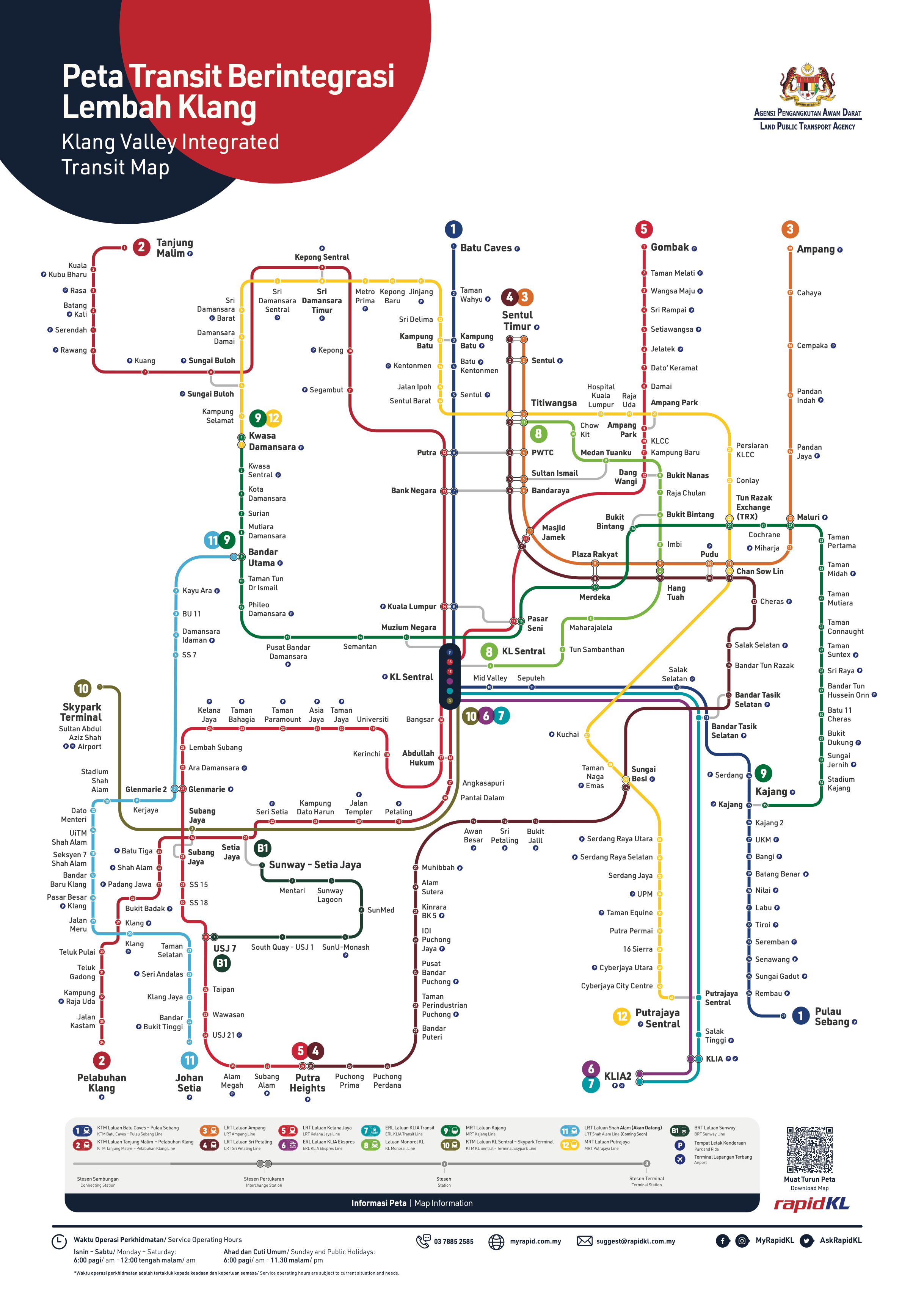
For a truly authentic and seamless KL experience, look no further than the city’s public transport. Hop on the MRT, glide above the streets on the Monorail, and connect effortlessly to every corner — your adventure, minus the stress and cost, awaits.
KLIA Ekspres is the fastest non-stop train transfer between the Kuala Lumpur city center and the KLIA Terminal 1 and KLIA Terminal 2 with a total journey time of only 33 minutes.
KLIA Transit is a rapid transit service designed specially for travelers and airport personnel to travel from Kuala Lumpur to KLIA Terminal 1 and KLIA Terminal 2 quickly.
MRT Putrajaya Line serves a corridor with a population of around 2 million people stretching from Kwasa Damansara to Putrajaya, Malaysia’s federal administrative centre.
MRT Kajang line covers a span of 47 kilometres from Kwasa Damansara to Kajang, passing the Kuala Lumpur city centre.
Ampang line LRT begins at Sentul Timur and a trip from Sentul Timur to Ampang takes an estimated 41 minutes.
Sri Petaling line LRT begins from Putra Heights and a trip from Putra Heights to Sentul Timur takes about 74 minutes.
Kelana Jaya Line LRT is a fully automated and driverless rail system that travels between Putra Heights and Gombak on 46km rail tracks.
KL Monorail is an urban monorail system built to service the Kuala Lumpur’s district. It is 8.6 km long and it has 11 stations.
GoKL City Buses improve public mobility in the areas of Bukit Bintang and Chinatown, slowly expanding to cover Kuala Lumpur’s wider area.
Port Klang Line KTM covers 131km of rail tracks with 34 stations. Port Klang Line runs between Tanjung Malim and Pelabuhan Klang (Port Klang).
Seremban Line KTM covers 135km of rail tracks with 28 stations. Seremban Line runs between Batu Caves and Tampin / Pulau Sebang.
Skypark Link is a KTM train service that connects you from the KL Sentral to Subang Jaya, and finally to Terminal Skypark station.
Unlock the real magic of Kuala Lumpur! Ditch the traffic and discover the city’s vibrant energy, hidden gems, and iconic landmarks effortlessly with its modern, affordable, and surprisingly easy-to-use public transportation system.
Turn your itinerary into an unforgettable journey!
The Malaysian Expressway System is a network of national controlled-access Expressways in Malaysia that forms the primary backbone network of Malaysian national highways. Malaysian toll road-expressways are built by private companies under the supervision of the government highway authority, Malaysian Highway Authority (LLM).


The North-South Expressway (NSE) / PLUS Expressway links many major cities and towns in western Peninsular Malaysia, acting as the ‘backbone’ of the west coast of the peninsula.
Kuala Lumpur boasts a dazzling array of palaces of attraction and it is home to iconic landmarks that capture the essence of Malaysia’s rich heritage and dynamic spirit. Check out these KL’s attractions!

Welcome to Your Independent Guide
klia2.info is a passion project created by and for travelers. We are an independent resource dedicated to helping you navigate Kuala Lumpur’s airports with ease and confidence. Our detailed guides, tips, and insights are based on first-hand experience, meticulous research, and official sources — not paid partnerships or sponsorship.
Our only goal is to provide the clear, honest, and practical information you need for a seamless journey, from curb to gate and beyond.